Google Reader Would Have Been 21 Today
 3 min read
240 views
3 min read
240 views
I saw an article today claiming that reading for just 30 minutes a day can support cognition and well-being, and even help us understand and connect with other people. I agree, but I also think it depends a lot on what you're reading.
These days it's easy to hop on your platform of choice and doomscroll for hours, enjoying all the ads and sponsored posts along the way. Your feed was probably crafted by an algorithm designed to push your emotional buttons and get a reaction out of you. That's how we do things now, but it wasn't always the case.
Back in the early aughts, you actually had to go out and find something to read. It wasn't just piped into your page. It was an age when men were real men, women were real women, and small furry creatures from Alpha Centauri were real small furry creatures from Alpha Centauri.
Then, on October 7, 2005 (twenty-one years ago today), Google launched Google Reader, which let you subscribe to your favorite blogs without trawling the whole internet to keep up with them. Google shut it down on July 1, 2013, citing declining usage, a shift toward mobile news apps, and no real way to monetize it. Mostly, I think, it was because I liked it.
I spent a few years working on Dismal Threads, a Reddit-like forum where I could create bot accounts, give each one a set of RSS feeds to poll, and have it post anything new it found to the forum. Looking back, I think I built a forum application when what I really wanted was a good, old-fashioned feed reader.
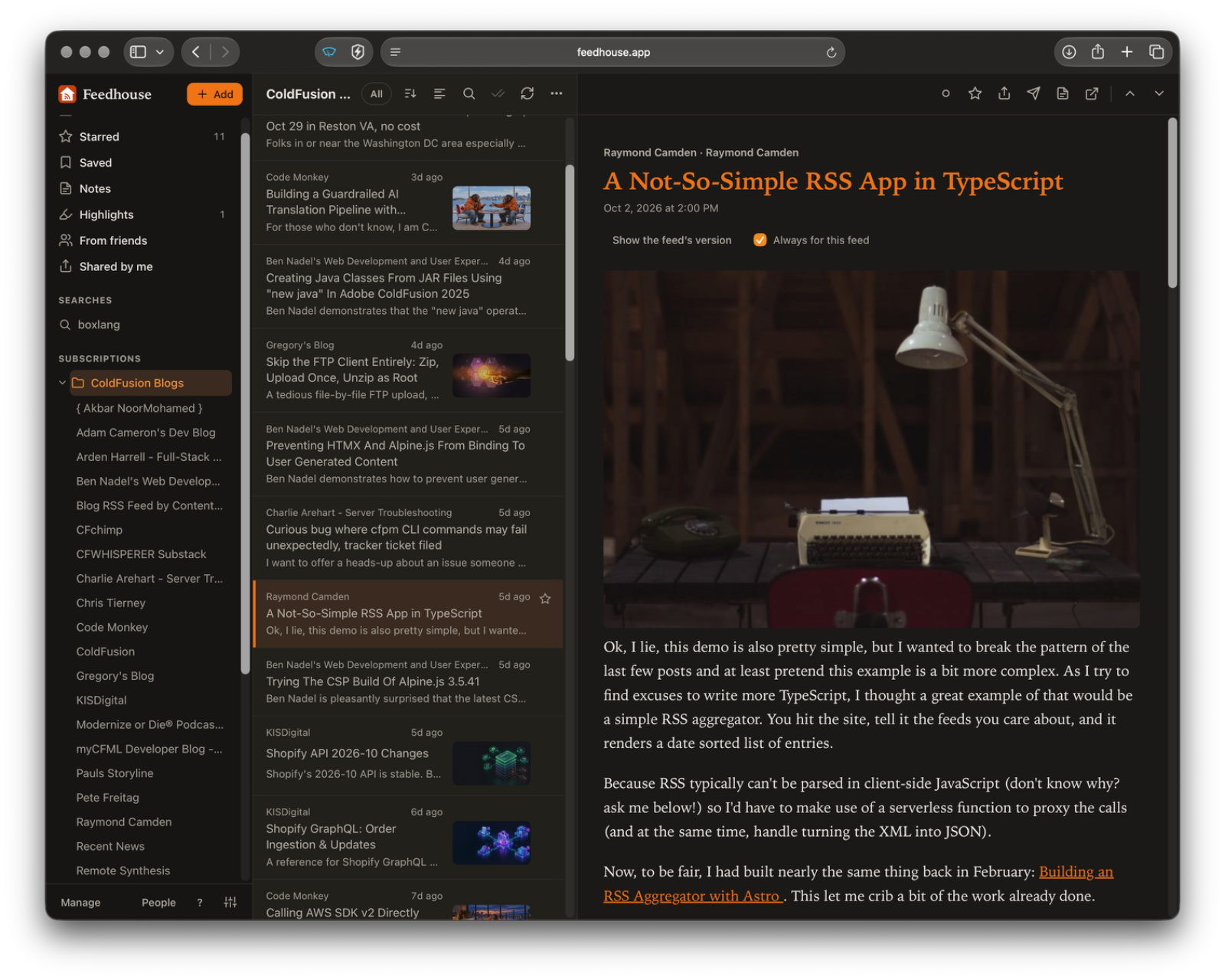
So what would that feed reader look like if I built it today? As it turns out, it would look like this:
What it does
The short version: you pick the sources, it shows you what's new in the order it was published, and nothing ranks your feed for you.
- Feeds: RSS and Atom, which covers more than you'd think: YouTube channels, podcasts, subreddits, GitHub, Mastodon and Bluesky. Paste a page and Feedhouse finds the feed. OPML import and export, so you can leave whenever you like.
- Reading: unread and starred, folders, oldest or newest first, and comfortable, compact or card views. For feeds that only send a summary, it fetches the full article. Keyboard shortcuts for the
j/kcrowd. - Read later: save any link, highlight passages, attach private notes, and export your highlights as Markdown for Obsidian.
- Search: full-text across everything you follow and save. Pin a search to the sidebar and it gets its own unread count.
- People: follow other readers, share items with a note, and comment. It's the social layer Reader had before Google bolted it onto Google+ and then took it away.
- On a phone: an installable PWA with offline reading, swipe gestures, pull to refresh and push notifications.
- Privacy: feed HTML is sanitized on the server, and images load through Feedhouse's own proxy, so publishers never see your IP address.
It's built on BoxLang with BoxExpress on the server and React on the front end, backed by MySQL.
Sign-ups are open. Bring your OPML.
If you are ready to follow all of your favorite ColdFusion bloggers you can follow this bundle: https://feedhouse.app/b/toQxcm3YHxnA
No comments yet — be the first.